


The evolution of the digital advertising ecosystem in recent years has been shaped by a fundamental shift in the privacy landscape and the way organizations control user data. The phase-out of third-party cookies, restrictions introduced by browsers such as Safari and Firefox, and the growing adoption of ad blockers have caused traditional web analytics approaches to become increasingly unstable. As a result, a significant portion of marketing signals disappears before reaching analytics and advertising platforms.
In this context, Google introduced a solution called Google Tag Gateway (GTG), previously known as First-Party Mode. The technology is designed to restore measurement accuracy while maintaining user privacy and strengthening organizations’ control over their data infrastructure.
How Google Tag Gateway works
Google Tag Gateway is a first-party routing technology that changes the way browsers communicate with Google measurement servers. In a standard analytics setup, scripts such as Google Tag Manager or Google Analytics 4 are loaded directly from Google-owned domains, such as googletagmanager.com or google-analytics.com. Modern browser protection mechanisms and ad blockers often classify these requests as third-party interactions, making them common targets for blocking or restriction.
The primary challenge addressed by GTG is the loss of measurement signals caused by blocked requests to third-party domains. In traditional implementations, this may result in losing approximately 10–30% of events, depending on the environment, user behavior, and level of browser restrictions. Implementing GTG can help recover part of this lost signal, with the impact varying by industry and audience profile. Differences are often more visible in sectors with a high share of Safari users or privacy-focused audiences.
The result is improved data completeness, which leads to stronger models and better marketing decisions.
A new model for collecting marketing data
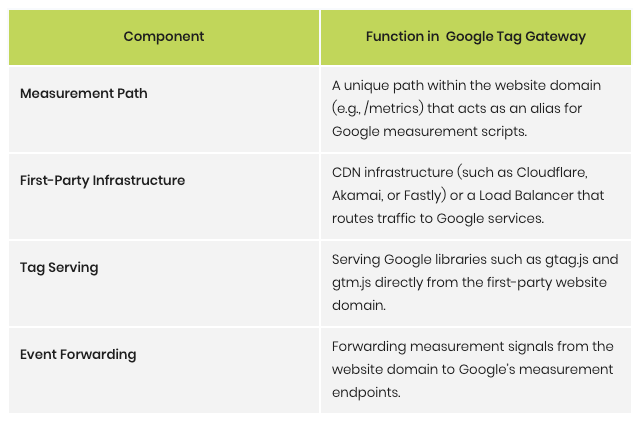
Google Tag Gateway enables advertisers to deploy Google tags using their own first-party infrastructure, hosted directly within their website domain. Instead of sending data to external Google domains, traffic is routed through an internal path within the website domain, for example: yourwebsite.com/metrics or yourwebsite.com/gtm. This infrastructure is typically built using content delivery networks (CDNs) such as Cloudflare, Akamai, or Fastly, or through solutions such as Google Cloud Load Balancers. It functions as an intelligent proxy layer between the user’s browser and Google’s measurement systems.
From the browser’s and security systems’ perspective, all analytics requests appear to be internal website traffic. The browser loads the tagging script from the website’s own domain and then sends measurement events back to the same domain, where they are forwarded to Google’s destination servers. Google Tag Gateway therefore acts as an intelligent routing layer: it preserves the client-side tagging logic while changing the data transmission path, making the measurement infrastructure more resilient to privacy restrictions and blocking mechanisms.
The foundation of Google Tag Gateway is the use of an organization’s existing web infrastructure. Unlike a full server-side Google Tag Manager implementation, GTG does not require a dedicated application server instance responsible for processing tagging logic. Instead, it relies primarily on edge-level routing configuration and network infrastructure.
Impact on analytics data accuracy and quality
Market data and tests conducted by Google and independent analytics agencies indicate a measurable increase in the number of recorded events after implementing Google Tag Gateway (GTG). The average increase in observed conversions is approximately 11%, although in specific environments with a high level of tracking restrictions - such as premium audiences with a large share of Safari users - the improvement can be significantly higher.
In privacy-sensitive industries, such as insurance, there have been cases where more than 20.5% of previously lost signals were recovered. This directly contributes to improved attribution accuracy and more effective campaign optimization.
The improvement comes from the fact that domain-based blockers typically do not recognize requests sent to paths such as yourwebsite.com/metrics as tracking scripts unless these domains or paths are explicitly added to blocking lists. While advanced privacy extensions, such as Ghostery, can identify GA4-related signatures even within proxied traffic, GTG effectively reduces the impact of commonly used browser-level restrictions.
Business and operational benefits
1. Better Media Decisions (ROAS and CPA)
A higher volume of recovered conversion signals provides more stable data for automated bidding algorithms. In practice, this leads to: improved budget allocation, more accurate attribution, higher return on advertising spend (ROAS), more effective campaign optimization. For example, a large home improvement retailer recorded a 15% increase in conversions attributed directly to paid marketing activities after implementing GTG. This enabled the company to shift budgets toward campaigns generating the strongest results. In the insurance sector, improved signal density contributed to an 18.7% reduction in customer acquisition cost (CPA) due to better training of automated bidding models.
2. Improved Website Performance and User Experience
GTG reduces the number of requests sent to external domains by moving part of the delivery process into CDN-based infrastructure. This allows scripts to be served from edge locations closer to users. Fewer external requests and improved edge caching can positively influence Core Web Vitals performance, which may indirectly support SEO visibility and improve website conversion rates.
3. Security and Privacy Management
Centralizing analytics traffic within a first-party domain makes data flow easier to control and improves alignment with privacy frameworks such as Consent Mode. User privacy preferences continue to be respected, while the transport layer becomes more reliable and less vulnerable to issues caused by unstable third-party connections.
Google Tag Gateway vs. Server-Side GTM
A common mistake is treating Google Tag Gateway as an alternative to server-side GTM. In reality, these solutions address different needs. The decision between Google Tag Gateway and sGTM depends on technological maturity, data control requirements, and advertising budget. GTG is often described as a lightweight proxy, while sGTM serves as a complete data management command center.
The main difference is the lack of processing capabilities in GTG. The Gateway only forwards requests and does not allow them to be modified. sGTM enables organizations to capture data, clean it (for example, removing phone numbers or email addresses before sending), enrich it with CRM data, and distribute it to multiple systems simultaneously from a single incoming event.
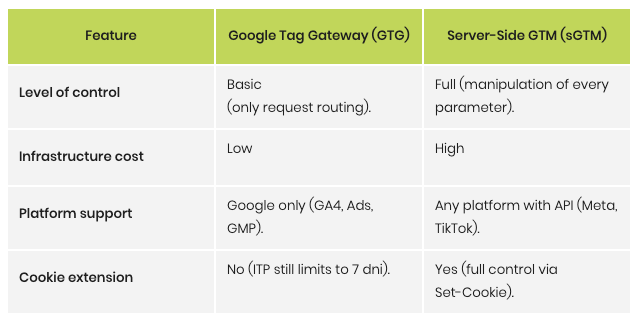
It is worth noting that these two solutions do not have to be mutually exclusive. A hybrid architecture allows the use of Google Tag Gateway for fast and cost-efficient delivery of Google tags at the edge of the network, while directing selected critical events to a server-side GTM container for advanced processing and sending data to Meta CAPI. This approach helps balance costs - sGTM does not need to process every page view, but only key conversion events - while maintaining performance and data control.
Strategic Recommendations
In a world of cookie restrictions and increasing data control, the competitive advantage belongs not to organizations that collect more data, but to those that collect it more consistently and accurately. Google Tag Gateway represents a key step in the democratization of advanced data collection techniques. For years, routing data through first-party infrastructure was reserved for highly advanced organizations requiring expensive server maintenance. With GTG, Google has lowered the entry barrier to this level of analytics, making it accessible to almost any website owner using modern CDN services.
The impact of this technology on analytics is clearly positive, it:
restores lost signals,
feeds bidding algorithms with better-quality data,
strengthens first-party data strategies,
enables better marketing decision-making.
However, it is not a magic tool and does not solve all analytics challenges. Crucially, it removes one of the biggest barriers - signal loss.
In a world where privacy and data accuracy are two sides of the same coin, Google Tag Gateway offers a rare balance: it respects user choices while still providing marketers with the data needed to survive in an increasingly competitive digital landscape.
Do not let browser restrictions distort your view of success.
From Salestube’s perspective, the biggest challenge in analytics today is not the lack of tools, but the quality and completeness of input data feeding decision-making systems. Google Tag Gateway is one of the elements that helps restore that quality, but real value only appears when data is consistently integrated with attribution models, media, and business KPIs.
Is your analytics reporting fewer conversions than you see in your sales systems? Do you want to check how much signal you are losing in your current analytics stack and how it affects ROAS? Contact us!
Set up Google Tag Gateway today - it is an investment that can increase your reported performance metrics.
Check your domain status in the GTM admin panel and join market leaders who are already building a durable advantage through data.
'%3e%3cpath%20d='M12.0712%205.87001L45.6719%2016.8181L13.7984%2020.4706L12.0712%205.87001Z'%20fill='%232A87DF'/%3e%3cpath%20d='M15.5232%2035.0719L45.6719%2016.8181L13.7985%2020.4706L15.5232%2035.0719Z'%20fill='%232A87DF'/%3e%3cpath%20d='M13.2906%2016.1663L10.5489%2020.8428L13.8004%2020.4706L13.2906%2016.1663Z'%20fill='%23ED1C24'/%3e%3cpath%20d='M13.7985%2020.4705L14.3057%2024.7755L10.547%2020.8428'%20fill='%23ED1C24'/%3e%3cpath%20d='M45.6735%2016.8181L13.2903%2016.1663L10.5486%2020.8428L45.6735%2016.8181Z'%20fill='%231F5F96'/%3e%3cpath%20d='M45.6735%2016.8181L14.3072%2024.7755L10.5486%2020.8428L45.6735%2016.8181Z'%20fill='%233566C0'/%3e%3c/g%3e%3cdefs%3e%3cclipPath%20id='clip0_1746_13129'%3e%3crect%20width='34.6962'%20height='30.5797'%20fill='white'%20transform='translate(15.3242)%20rotate(28.9945)'/%3e%3c/clipPath%3e%3c/defs%3e%3c/svg%3e)
'%3e%3cpath%20d='M11.5674%2011.6151L74.4339%2016.0111L20.8238%2036.2316L11.5674%2011.6151Z'%20fill='%23FFB901'/%3e%3cpath%20d='M30.0747%2060.8505L74.4325%2016.0111L20.8224%2036.2317L30.0747%2060.8505Z'%20fill='%23FFB901'/%3e%3cpath%20d='M18.0934%2028.9749L15.354%2038.2938L20.823%2036.2317L18.0934%2028.9749Z'%20fill='white'/%3e%3cpath%20d='M20.8254%2036.2316L23.5511%2043.4907L15.3564%2038.2937'%20fill='white'/%3e%3cpath%20d='M74.4337%2016.0111L18.094%2028.9749L15.3546%2038.2938L74.4337%2016.0111Z'%20fill='%23CA9200'/%3e%3cpath%20d='M74.4337%2016.0111L23.5493%2043.4907L15.3546%2038.2938L74.4337%2016.0111Z'%20fill='%23DEA100'/%3e%3c/g%3e%3cdefs%3e%3cclipPath%20id='clip0_1746_13099'%3e%3crect%20width='61.8621'%20height='54.7921'%20fill='white'%20transform='translate(14.6797)%20rotate(15)'/%3e%3c/clipPath%3e%3c/defs%3e%3c/svg%3e)

'%3e%3cpath%20d='M21.2539%2011.4723C21.2539%2017.1352%2016.6629%2021.7262%2011%2021.7262C5.3371%2021.7262%200.746094%2017.1352%200.746094%2011.4723C0.746094%205.80939%205.3371%201.21838%2011%201.21838C16.6629%201.21838%2021.2539%205.80939%2021.2539%2011.4723Z'%20fill='white'/%3e%3cpath%20d='M17.1273%2012.2972V16.5249H14.6765V12.581C14.6765%2011.5903%2014.3231%2010.9138%2013.435%2010.9138C12.7585%2010.9138%2012.356%2011.3699%2012.1784%2011.8108C12.1132%2011.9679%2012.0972%2012.1865%2012.0972%2012.4079V16.5249H9.64549C9.64549%2016.5249%209.6785%209.8446%209.64549%209.15304H12.0972V10.198C12.0927%2010.2061%2012.0856%2010.214%2012.0811%2010.222H12.0972V10.198C12.4229%209.69654%2013.0039%208.97979%2014.3061%208.97979C15.9189%208.97979%2017.1273%2010.0338%2017.1273%2012.2972ZM7.08226%205.59985C6.24328%205.59985%205.69531%206.15053%205.69531%206.87347C5.69531%207.5812%206.22724%208.14696%207.05014%208.14696H7.06532C7.92033%208.14696%208.45226%207.58124%208.45226%206.87347C8.43618%206.15057%207.92033%205.59985%207.08226%205.59985ZM5.8408%2016.5249H8.2907V9.15304H5.8408V16.5249Z'%20fill='%233579B0'/%3e%3c/g%3e%3cdefs%3e%3cclipPath%20id='clip0_1830_427'%3e%3crect%20width='21'%20height='21'%20fill='white'%20transform='translate(0.5%200.936218)'/%3e%3c/clipPath%3e%3c/defs%3e%3c/svg%3e)