


It’s not about how much you spend, but when it stops paying off.
The pressure to deliver results keeps growing, and the usual response is: “Let’s just add more to the media budget.” Sound familiar?
In theory, more spend should lead to more conversions. But in reality, it only works up to a point. Every channel has a saturation limit. After that, extra budget raises costs without improving performance.
With rising CPCs, the loss of third-party cookies, and a growing mix of platforms (Meta, Google, TikTok, CTV, retail media), effective budget allocation isn’t optional, it’s essential.
The real challenge isn’t deciding how much to spend, but knowing when to stop increasing spend in a specific channel.
So how do you identify that tipping point before your CAC spikes and ROAS drops?
📥 Download our guide:
See where you can boost performance today - without overhauling your entire media strategy.
What Is Media Saturation?
Media saturation is when your budget stops working. When spending more in a specific channel no longer delivers proportional returns.
You spend more, but conversions grow more slowly.
mCPA increases.
ROAS declines.
CTR drops while ad frequency rises (especially in social media).
The cost per incremental user keeps climbing.
This happens across nearly all channels. It’s the law of diminishing returns in action: the first $10,000 often delivers more than the last $10,000 of a $100,000 budget.
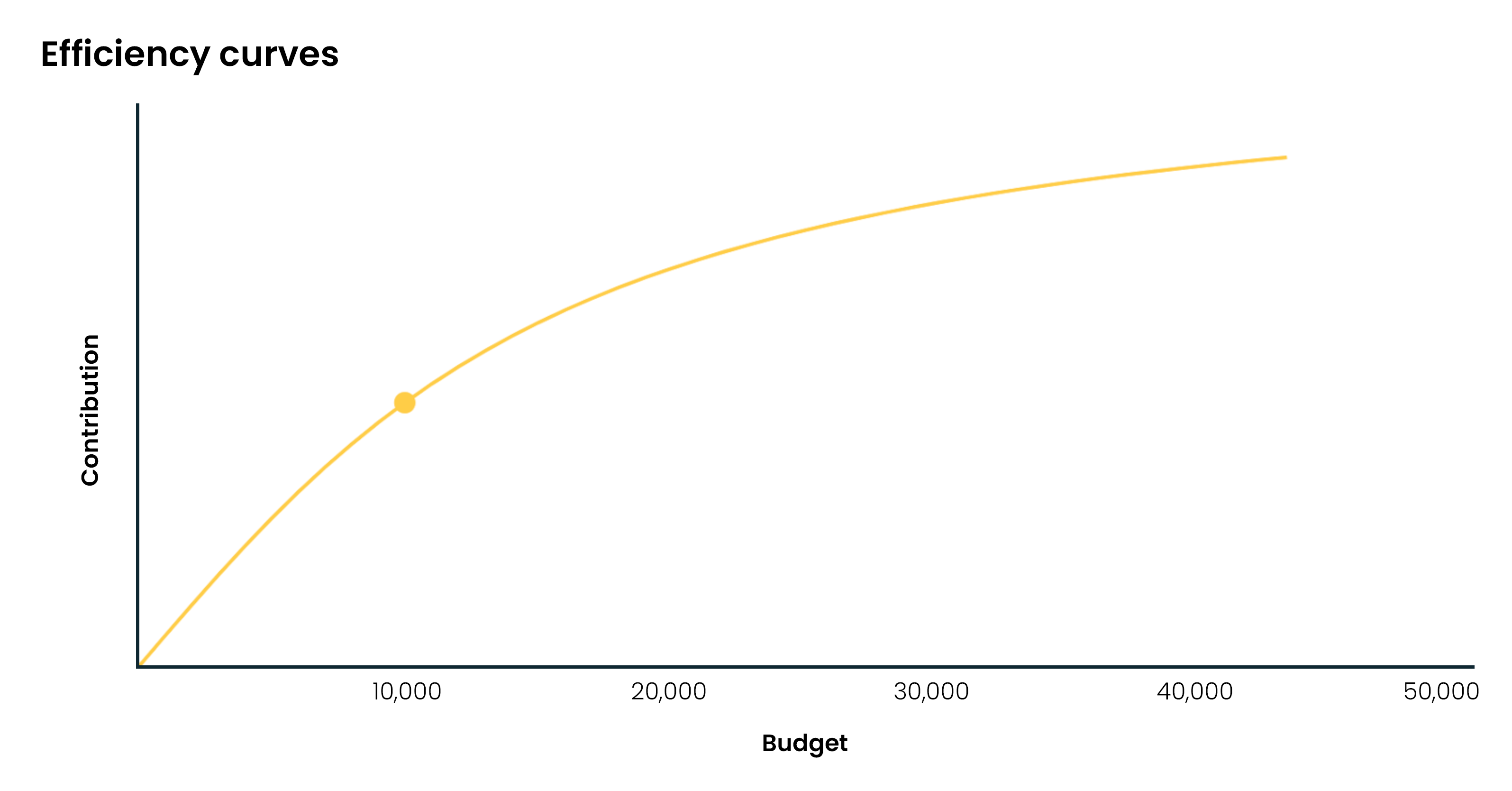
Yet marketers often stick to their “hero channels.” Out of habit, pressure, or risk aversion, they keep investing in the same platforms, even after those platforms have passed their peak effectiveness.
How to Detect the Saturation Point
Saturation doesn’t happen overnight. Your job is to recognize when you're getting close. These signals can act as early warnings:
Declining Marginal ROASIf your spend is rising faster than your revenue, ROAS will fall. It’s simple math.
Rising mCPA with budget increasesDon’t just look at the average CPA. Calculate the cost of incremental conversions. If the next round of spending delivers conversions at twice the cost, you’re entering dangerous territory.
Flattening Conversion CurveIf a 20% budget increase yields 20% more conversions, that’s great. But if it only gets you 10% more, then 5%, the curve is flattening, and efficiency is slipping.
CTR drops + Frequency risesThis combo is deadly, especially on social media. When platforms try to spend your budget by showing the same ad to the same users repeatedly, they get annoyed. Engagement plummets.
Impression Share >90% in Google AdsYou’ve already maxed out the audience for your keywords. Beyond this point, you’re just bidding up CPCs, not driving more conversions.
Why Classic Optimization Isn’t Enough
Channel-level tweaks only solve short-term problems. But what comes next?
Which channel still has room to grow?
Where should you shift the budget to increase total ROAS?
How do you evaluate results now that click-based attribution no longer works?
To answer these questions, you need a broader view of your entire marketing mix. That’s where Marketing Mix Modeling (MMM) comes in.
Marketing Mix Modeling (MMM): Smarter Budget Allocation
MMM is a statistical method that analyzes how different marketing activities (online and offline), along with external factors like seasonality, affect sales. It uses aggregated data (such as weekly spend), so it doesn’t rely on cookies or user-level tracking.
Its greatest value? Media response curves.
These show, for each channel:
Where performance is strongest.
Where efficiency begins to drop.
Where additional spend becomes waste.
Unlike attribution models, which track clicks, MMM answers strategic questions, such as:
"How much will sales increase if we raise the TV budget by $100,000?"
The key output from MMM is the media response curve. For each channel, the curve shows the expected sales increase at different levels of spend:
A steep curve shows high efficiency and growth potential.
A flattening curve signals saturation is near.
A flat curve means the channel is fully saturated and spending more won’t help.
In Practice: Three Channels, Three Curves
As an example, we can use an e-commerce company in the apparel industry that has been investing in three channels: Meta Ads, Google Search, and Retail Media, allocating similar amounts to each.
This intuitive strategy, though simple to manage, began to reveal its flaws: despite steady spending, sales growth was noticeably slowing, and ROI was gradually but alarmingly declining. MMM modeling showed:
Retail media – high mROI, strong scaling potential. Despite previous investments, additional spent in this channel would deliver a very high marginal return.
Google – stable efficiency but close to saturation. Further increases in budget would bring much smaller sales gains relative to costs.
Meta – low conversion with high frequency. The pool of effective audiences had already been exhausted. Continued investment in this channel in its current form clearly resulted in budget waste.
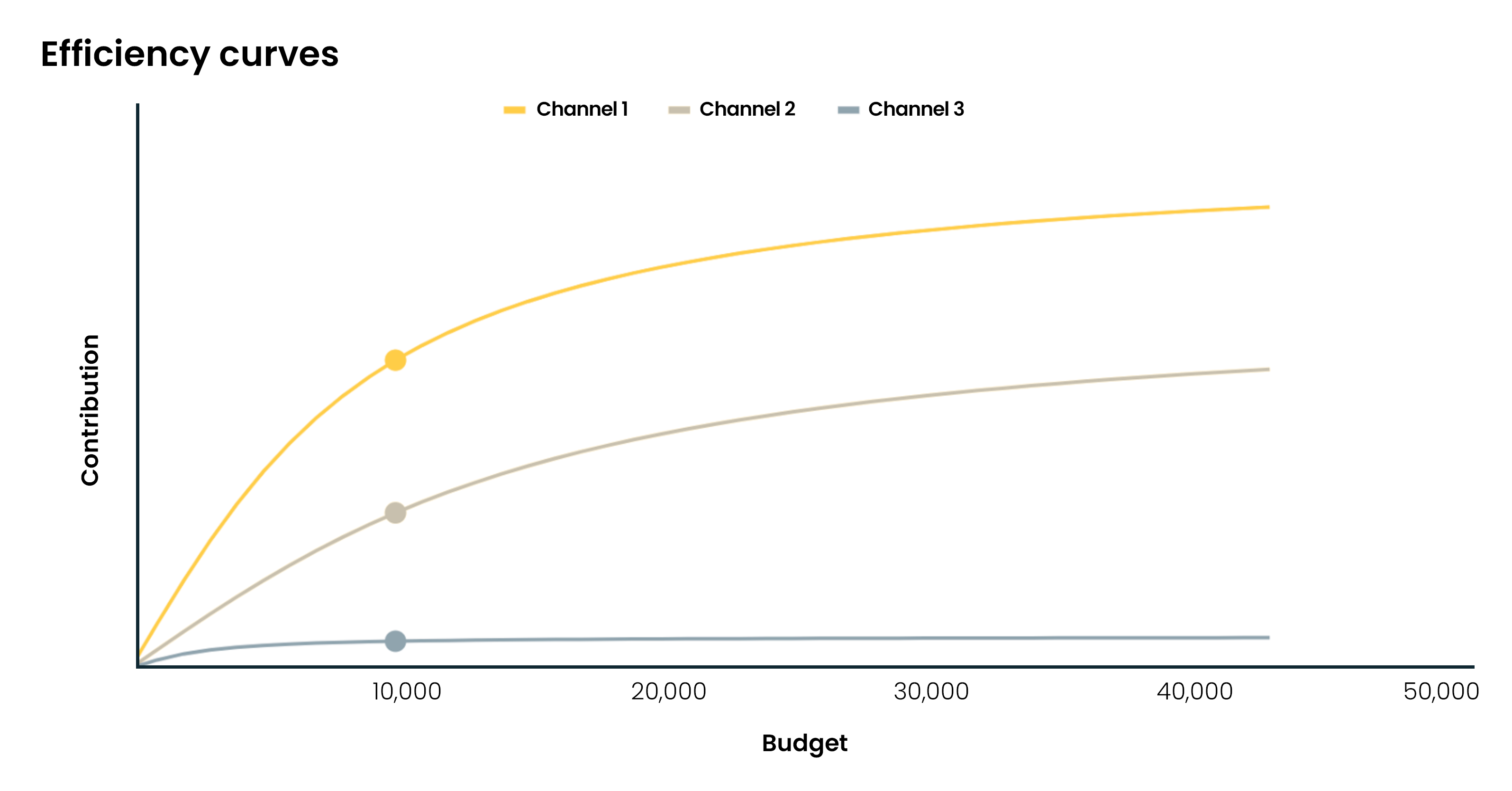
Following precise recommendations from the MMM model, generated by the sMMMart AI tool, the company made a bold but informed move:
Spend on Meta was reduced.A moderate investment level in Google was maintained to leverage its stable potential, while avoiding excessive waste.
A significant portion of the freed-up budget was strategically shifted to Retail Media.
The result? Without increasing total budget, the company raised ROAS in the next quarter.
How to use MMM in practice?
You don’t need a full data science team or months of setup to use MMM. Tools like sMMMart AI make it accessible by:
Integrating data from media platforms and CRM/CDP systems.
Automatically building MMM models tailored to your brand.
Generating media response curves and actionable budget recommendations.
Running regularly (e.g., every 2 weeks or monthly).
With tools like this, you spend where it actually works, not just where the system is able to spend.
This helps you:
Maximize ROI and ROAS by focusing budget on high-return areas.
Avoid waste by spotting saturation early.
Get a clear view of your full media mix - across both digital and offline.
Receive recurring, data-based insights that match your planning cycles.
Stay effective even without cookies, since MMM relies on aggregated data.
Summary: Precision over intuition
It’s no longer about growing your budget - it’s about making sure every dollar or zloty delivers value.
Running campaigns without understanding saturation points is like flying blind.
MMM, especially automated tools like sMMMart AI, helps you invest with confidence and impact, not just spend more.
You don’t need to fully implement MMM today to reduce budget waste. Start small.
Download our guide:
See where you can boost performance today - without overhauling your entire media strategy.
'%3e%3cpath%20d='M12.0712%205.87001L45.6719%2016.8181L13.7984%2020.4706L12.0712%205.87001Z'%20fill='%232A87DF'/%3e%3cpath%20d='M15.5232%2035.0719L45.6719%2016.8181L13.7985%2020.4706L15.5232%2035.0719Z'%20fill='%232A87DF'/%3e%3cpath%20d='M13.2906%2016.1663L10.5489%2020.8428L13.8004%2020.4706L13.2906%2016.1663Z'%20fill='%23ED1C24'/%3e%3cpath%20d='M13.7985%2020.4705L14.3057%2024.7755L10.547%2020.8428'%20fill='%23ED1C24'/%3e%3cpath%20d='M45.6735%2016.8181L13.2903%2016.1663L10.5486%2020.8428L45.6735%2016.8181Z'%20fill='%231F5F96'/%3e%3cpath%20d='M45.6735%2016.8181L14.3072%2024.7755L10.5486%2020.8428L45.6735%2016.8181Z'%20fill='%233566C0'/%3e%3c/g%3e%3cdefs%3e%3cclipPath%20id='clip0_1746_13129'%3e%3crect%20width='34.6962'%20height='30.5797'%20fill='white'%20transform='translate(15.3242)%20rotate(28.9945)'/%3e%3c/clipPath%3e%3c/defs%3e%3c/svg%3e)
'%3e%3cpath%20d='M11.5674%2011.6151L74.4339%2016.0111L20.8238%2036.2316L11.5674%2011.6151Z'%20fill='%23FFB901'/%3e%3cpath%20d='M30.0747%2060.8505L74.4325%2016.0111L20.8224%2036.2317L30.0747%2060.8505Z'%20fill='%23FFB901'/%3e%3cpath%20d='M18.0934%2028.9749L15.354%2038.2938L20.823%2036.2317L18.0934%2028.9749Z'%20fill='white'/%3e%3cpath%20d='M20.8254%2036.2316L23.5511%2043.4907L15.3564%2038.2937'%20fill='white'/%3e%3cpath%20d='M74.4337%2016.0111L18.094%2028.9749L15.3546%2038.2938L74.4337%2016.0111Z'%20fill='%23CA9200'/%3e%3cpath%20d='M74.4337%2016.0111L23.5493%2043.4907L15.3546%2038.2938L74.4337%2016.0111Z'%20fill='%23DEA100'/%3e%3c/g%3e%3cdefs%3e%3cclipPath%20id='clip0_1746_13099'%3e%3crect%20width='61.8621'%20height='54.7921'%20fill='white'%20transform='translate(14.6797)%20rotate(15)'/%3e%3c/clipPath%3e%3c/defs%3e%3c/svg%3e)

'%3e%3cpath%20d='M21.2539%2011.4723C21.2539%2017.1352%2016.6629%2021.7262%2011%2021.7262C5.3371%2021.7262%200.746094%2017.1352%200.746094%2011.4723C0.746094%205.80939%205.3371%201.21838%2011%201.21838C16.6629%201.21838%2021.2539%205.80939%2021.2539%2011.4723Z'%20fill='white'/%3e%3cpath%20d='M17.1273%2012.2972V16.5249H14.6765V12.581C14.6765%2011.5903%2014.3231%2010.9138%2013.435%2010.9138C12.7585%2010.9138%2012.356%2011.3699%2012.1784%2011.8108C12.1132%2011.9679%2012.0972%2012.1865%2012.0972%2012.4079V16.5249H9.64549C9.64549%2016.5249%209.6785%209.8446%209.64549%209.15304H12.0972V10.198C12.0927%2010.2061%2012.0856%2010.214%2012.0811%2010.222H12.0972V10.198C12.4229%209.69654%2013.0039%208.97979%2014.3061%208.97979C15.9189%208.97979%2017.1273%2010.0338%2017.1273%2012.2972ZM7.08226%205.59985C6.24328%205.59985%205.69531%206.15053%205.69531%206.87347C5.69531%207.5812%206.22724%208.14696%207.05014%208.14696H7.06532C7.92033%208.14696%208.45226%207.58124%208.45226%206.87347C8.43618%206.15057%207.92033%205.59985%207.08226%205.59985ZM5.8408%2016.5249H8.2907V9.15304H5.8408V16.5249Z'%20fill='%233579B0'/%3e%3c/g%3e%3cdefs%3e%3cclipPath%20id='clip0_1830_427'%3e%3crect%20width='21'%20height='21'%20fill='white'%20transform='translate(0.5%200.936218)'/%3e%3c/clipPath%3e%3c/defs%3e%3c/svg%3e)