


See if you're repeating costly errors and learn what you can adjust now before making your next move.
Your customers move without borders. Does your data keep up?
Today's consumer moves seamlessly across channels: they see an ad on TV, browse the product in a mobile app, touch it in a brick-and-mortar store, and finalize the purchase on a marketplace. For them, it's one coherent journey. For you, it often means fragmented data sources that don’t talk to each other.
The result? We still too often analyze performance in silos - separately for e-commerce, physical stores, or offline campaigns. This not only distorts the bigger picture but can also lead to misguided budget decisions.
So, is it possible, without a full tech overhaul or a data science team, to merge scattered data into one cohesive view that enables insights across the entire journey, not just within individual channels?
Why do traditional measurement approaches fail for omnichannel?
The main barrier is data silos. Each channel, from CRM and physical stores to the rapidly growing social commerce, mobile apps, offline campaigns, and social media, reports in its own way. Last-click attribution models ignore the impact of earlier touchpoints. Offline activities don’t have an assigned measurable indicator, and top-of-funnel effects are often dismissed because “they don’t convert.”
An example? An outdoor campaign that didn’t generate any clicks or online transactions might appear completely ineffective. But during that time, foot traffic in physical stores increased by 15%. Classic analytics won’t reveal that.
That’s why omnichannel strategies need solutions that integrate data from all channels and measure the real impact of all marketing and sales efforts on key business metrics.
One such solution is Marketing Mix Modeling.
Marketing Mix Modeling - how to measure what really works
Marketing Mix Modeling (MMM) is a statistical econometric analysis that shows how specific marketing activities impact key business metrics, such as sales, conversions, profitability, or LTV, regardless of channel.
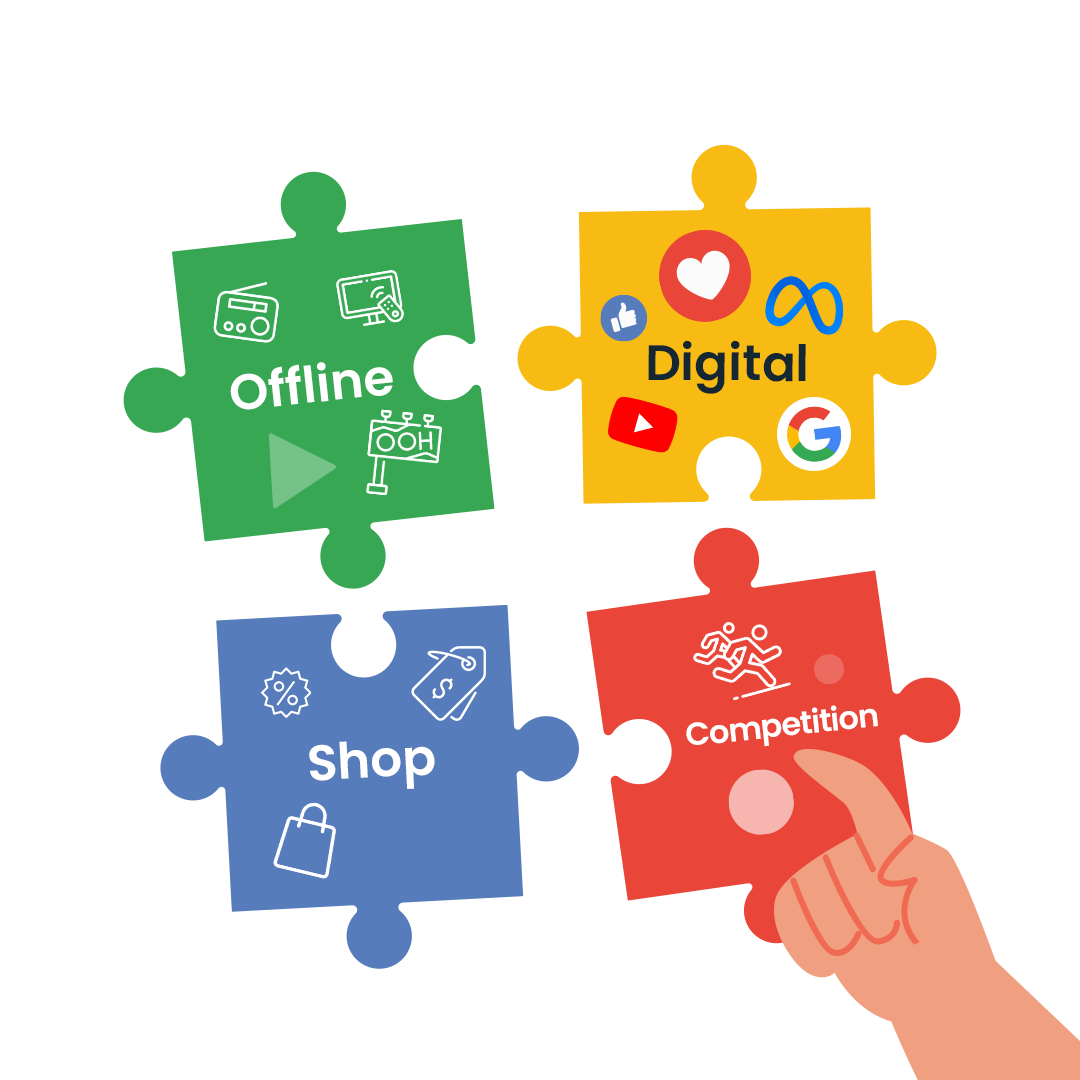
MMM integrates data from various sources including:
Digital campaigns (Google, Meta, programmatic)
Offline campaigns (TV, OOH, radio)
Influencer marketing activities
Prices, discounts, and product availability
Competitor activity
Macroeconomic and seasonal data (holidays, events, market trends, inflation, weather)
Traffic in-stores and mobile apps
The strength of MMM lies in its reliance on real historical data, not just digital attribution. By analyzing inter-channel dependencies and delayed effects, especially in top-of-funnel activities, the model accurately shows how individual channels impact sales, conversions, or other KPIs. This enables reliable estimation of each activity’s effectiveness and true ROI, allowing for more informed marketing budget optimization.
Real Omnichannel Challenges
Challenge | MMM Solution |
Data silos hinder analysis | Integrates online, offline, CRM, and app data into one coherent model |
Offline activities are hard to measure | Attributes the impact of TV, OOH, and in-store promotions on sales |
Customer journey analysis is difficult | Analyzes the full path from awareness and brand-building to lower-funnel sales campaigns |
Marketplaces and social commerce are out of reach | Measures their real impact on sales not just clicks |
Budget optimization is challenging | Identifies which channels truly and effectively drive sales performance |
And what about implementation? Do you have to be Amazon?
MMM doesn’t have to require years of implementation, a data science team, and an exorbitant budget.
Modern econometric solutions (such as sMMMart AI) democratize access to modeling thanks to:
Cloud-based operation (Google Cloud Platform)
No need for a specialized analytics team
Integration with existing systems (CRM, e-commerce, media tools)
Automated recommendations and budget simulations
Regularly updated models delivering fresh, up-to-date insights
This kind of solution represents a new approach to econometrics, which traditionally only assessed the past effectiveness of activities in a one-off manner.
In contrast, modern econometric tools refresh models at regular intervals, allowing you to test new, previously unexplored channels. They provide real-time results and enable immediate insights.
At the same time, they support ongoing optimization by enabling dynamic campaign planning and suggesting budget shifts to the best-performing channels to maximize sales or improve your selected KPI without delay. As a result, even teams without advanced analytical capabilities can successfully benefit from MMM.
Data synchronization is the new standard. Are you ready for it?
We’re not short on data nowadays. If anything, we have too much of it. The problem begins when that data is scattered and inconsistent, painting a false picture of reality. And an inconsistent customer view means a fragmented purchase experience, which is something consumers won’t forgive. Just like your finance report won’t forgive wasted ad spend.
Marketing Mix Modeling, especially in its modern, automated form, turns data into decisions - accurate, synchronized, and grounded in the reality of today’s omnichannel world.
We know implementing MMM isn’t a five-minute decision. It’s a process. But there are things you can fix today.
See if you're repeating costly errors and learn what you can adjust now before making your next move.
'%3e%3cpath%20d='M12.0712%205.87001L45.6719%2016.8181L13.7984%2020.4706L12.0712%205.87001Z'%20fill='%232A87DF'/%3e%3cpath%20d='M15.5232%2035.0719L45.6719%2016.8181L13.7985%2020.4706L15.5232%2035.0719Z'%20fill='%232A87DF'/%3e%3cpath%20d='M13.2906%2016.1663L10.5489%2020.8428L13.8004%2020.4706L13.2906%2016.1663Z'%20fill='%23ED1C24'/%3e%3cpath%20d='M13.7985%2020.4705L14.3057%2024.7755L10.547%2020.8428'%20fill='%23ED1C24'/%3e%3cpath%20d='M45.6735%2016.8181L13.2903%2016.1663L10.5486%2020.8428L45.6735%2016.8181Z'%20fill='%231F5F96'/%3e%3cpath%20d='M45.6735%2016.8181L14.3072%2024.7755L10.5486%2020.8428L45.6735%2016.8181Z'%20fill='%233566C0'/%3e%3c/g%3e%3cdefs%3e%3cclipPath%20id='clip0_1746_13129'%3e%3crect%20width='34.6962'%20height='30.5797'%20fill='white'%20transform='translate(15.3242)%20rotate(28.9945)'/%3e%3c/clipPath%3e%3c/defs%3e%3c/svg%3e)
'%3e%3cpath%20d='M11.5674%2011.6151L74.4339%2016.0111L20.8238%2036.2316L11.5674%2011.6151Z'%20fill='%23FFB901'/%3e%3cpath%20d='M30.0747%2060.8505L74.4325%2016.0111L20.8224%2036.2317L30.0747%2060.8505Z'%20fill='%23FFB901'/%3e%3cpath%20d='M18.0934%2028.9749L15.354%2038.2938L20.823%2036.2317L18.0934%2028.9749Z'%20fill='white'/%3e%3cpath%20d='M20.8254%2036.2316L23.5511%2043.4907L15.3564%2038.2937'%20fill='white'/%3e%3cpath%20d='M74.4337%2016.0111L18.094%2028.9749L15.3546%2038.2938L74.4337%2016.0111Z'%20fill='%23CA9200'/%3e%3cpath%20d='M74.4337%2016.0111L23.5493%2043.4907L15.3546%2038.2938L74.4337%2016.0111Z'%20fill='%23DEA100'/%3e%3c/g%3e%3cdefs%3e%3cclipPath%20id='clip0_1746_13099'%3e%3crect%20width='61.8621'%20height='54.7921'%20fill='white'%20transform='translate(14.6797)%20rotate(15)'/%3e%3c/clipPath%3e%3c/defs%3e%3c/svg%3e)

'%3e%3cpath%20d='M21.2539%2011.4723C21.2539%2017.1352%2016.6629%2021.7262%2011%2021.7262C5.3371%2021.7262%200.746094%2017.1352%200.746094%2011.4723C0.746094%205.80939%205.3371%201.21838%2011%201.21838C16.6629%201.21838%2021.2539%205.80939%2021.2539%2011.4723Z'%20fill='white'/%3e%3cpath%20d='M17.1273%2012.2972V16.5249H14.6765V12.581C14.6765%2011.5903%2014.3231%2010.9138%2013.435%2010.9138C12.7585%2010.9138%2012.356%2011.3699%2012.1784%2011.8108C12.1132%2011.9679%2012.0972%2012.1865%2012.0972%2012.4079V16.5249H9.64549C9.64549%2016.5249%209.6785%209.8446%209.64549%209.15304H12.0972V10.198C12.0927%2010.2061%2012.0856%2010.214%2012.0811%2010.222H12.0972V10.198C12.4229%209.69654%2013.0039%208.97979%2014.3061%208.97979C15.9189%208.97979%2017.1273%2010.0338%2017.1273%2012.2972ZM7.08226%205.59985C6.24328%205.59985%205.69531%206.15053%205.69531%206.87347C5.69531%207.5812%206.22724%208.14696%207.05014%208.14696H7.06532C7.92033%208.14696%208.45226%207.58124%208.45226%206.87347C8.43618%206.15057%207.92033%205.59985%207.08226%205.59985ZM5.8408%2016.5249H8.2907V9.15304H5.8408V16.5249Z'%20fill='%233579B0'/%3e%3c/g%3e%3cdefs%3e%3cclipPath%20id='clip0_1830_427'%3e%3crect%20width='21'%20height='21'%20fill='white'%20transform='translate(0.5%200.936218)'/%3e%3c/clipPath%3e%3c/defs%3e%3c/svg%3e)